


If you’re searching “skydiving San Francisco,” let’s save you a little time: you can’t actually jump out of a plane in San Francisco. Imagine aiming your parachute for Lombard Street, famous for being the most winding road on earth. Cool visual, bad idea.
But here’s the good news: some of the best skydiving in the entire country is close. Within two hours of the city, you’ve got options ranging from rugged coastal views to inland farmland, from beginner-friendly tandem jumps to serious training grounds for future solo jumpers.
This guide walks you through everything worth knowing before you fling yourself out of a perfectly good airplane near San Francisco:
By the end, you’ll know exactly where to go, what to expect, and how to make your first (or fiftieth) skydive in the Bay Area the best possible experience. And yes, we’ll give you the unvarnished truth on why Monterey Bay often wins the crown for SF Bay Area skydivers
👉 Want the quick answer? Check out our full San Francisco skydiving page here.
While there aren’t any skydives in San Francisco itself (dodging fog, Golden Gate traffic, and cable cars would be… messy), you don’t have to go far to find world-class skydiving. Within an hour or two, there are several options, each with its own vibe, scenery, and experience style.
Some offer cheap options, some are closer than others, and some offer the best skydiving experience near San Francisco. Let’s get into it.
No matter which option you pick, you’re still within striking distance of San Francisco. The best choice really comes down to what matters most: jaw-dropping skydiving views, sky-high altitudes, quick access, or a cheap, low altitude jump.
Pro tip: If you’re after a truly memorable jump, longer freefall, and cinematic oceanfront views, Monterey Bay is your go-to. Here, 18,000 foot tandem skydives are the norm, letting you enjoy up to 90 seconds of freefall, almost twice what you’d get inland. Below, towering dunes, the Pacific coastline, and seasonal snow-capped peaks create a view that makes any flat farmland or dusty airstrip look positively pedestrian, making the drive from SF feel effortlessly worthwhile.
[Insert Visual Prompt: Map of SF to Monterey Bay, Hollister, Davis, showing distances and drive times]
Weather in the SF Bay Area is….complicated. Coastal fog, inland heat, and microclimates all conspire to make choosing your jump day feel like decoding the Oracle of Delphi. Skydiving near San Francisco is all about timing and conditions. The SF Bay Area might look perpetually sunny from your Instagram feed, but in reality, it’s a patchwork of microclimates, coastal fog, and unique winds that can make or break a jump day. Knowing what to expect can save you from a soggy trip to the airport or a long wait while the fog lifts.
California Coastal skydive centers in Monterey Bay or Santa Cruz stay relatively mild year-round, usually ranging 50–70°F. Ocean breezes keep conditions comfortable, even in summer. Monterey’s coastal climate is cool, comfortable and predictable, perfect for summer jumps. Winter jumps call for mountain-hike logic: pile on the layers, shed them later, and thank yourself at altitude
Inland Dropzones close to SF can reach 100+F degrees, making the jump process anywhere from uncomfortable to unbearable. Excellent if you like being crammed into a small tin can with loads of people with lots of gear and excessive fear. Thermals can make your parachute ride bumpier. Winter temperatures swing significantly and can produce surprising chilly mornings so plan accordingly.

If you’re a SF local, you know fog is a part of life (we see you Karl). For you, as well as visitors to San Francisco, we’re here to set you straight on how fog and microclimates impact skydiving in general, but more specifically how it impacts skydiving in San Francisco Bay area.
The presence of fog usually prevents skydiving activity. Fog is cloud that touches the ground. Skydivers need visual contact with the ground to perform safe skydiving. So typically speaking if there is fog over the landing area, skydiving operations will likely be placed on a weather hold.
Coastal fog is a factor around the Bay Area, but it doesn’t affect every skydive location the same way. Along the Central Coast, places like Skydive Monterey Bay, Skydive Santa Cruz and Novota, typically have fog-free or low event fog from September through June. July and August are typically when fog is most common, though it can vary depending on the season and weather patterns.
Skydive Monterey Bay has a not-so-secret weapon against the summer fog: the fastest skydiving airplane on earth. It climbs fast enough to snag the short weather windows, which means you’re still jumping while other drop zones are grounded. Even if fog is present, the landing area sits right on the edge of more consistent open skies.
If you’re planning a jump in the cooler months and wondering how weather plays into it, this breakdown of winter skydiving conditions in Monterey Bay explains why winter is often one of the most reliable times to skydive in this region.
Central Valley Skydiving Centers: All other SF skydiving centers are in areas that must contend with “Tule Fog”. It affects the inland surrounding counties throughout the year, but specifically from late fall to early spring causing widespread visibility issues. Ultimately know that all San Francisco skydive centers are susceptible to regular fog occurrence.
Pro Tip: Microclimates mean you could leave San Francisco under clear skies and hit fog an hour later, or vice versa. Contact the skydiving center to get updated live conditions and jump statuses before you head out.
Wind speed, stability and direction affect safety. Coastal breezes can be stronger but are historically consistent and constant which provide ideal conditions for safe descents and soft, stand up landings. Skydive centers like Monterey and Santa Cruz have experienced pilots who know the microclimates and adjust flight plans accordingly.
Inland skydiving centers often experience inland thermal turbulence due to hot temperatures. The key word you likely picked up there was “turbulence”. If you’ve ever flown in an airplane, you likely know the effect of turbulence. It disrupts smooth flights and smooth landings.
While most of the Bay Area skydiving centers have a good safety record, skydiving in an area that has less turbulence increases your safety level. Smooth, constant ocean breezes provide consistent and predictable wind conditions for landing. The coastal skydiving centers do seem to sport longer standing safety records.
Pro tip: Coastal drop zones serve up the big-ticket stuff: ocean, beaches, cliffs, mountains, and unique to Monterey Bay, higher altitudes. The trade-off is they occasionally play a little harder to get with the weather than their inland compatriots. But when the skies line up, the payoff makes inland farmland look like, well, farmland.
Timing your jump is almost as important as choosing the drop zone itself. While the San Francisco Bay Area offers skydiving year-round, some days are better than others for visibility, comfort, and overall experience.
Weekdays: Less commute traffic, shorter lines, faster check-ins, and a quieter vibe make for a smooth, stress-free jump. Ideal if you like your first-time adrenaline with a side of calm.
Weekends: Expect slightly longer waits; still manageable at most centers if you book early. Long weekends are typically the busiest and also have that extra commute traffic to consider if you’re jump has you heading back to SF at the end of the long weekend.
Spring
Mild temperatures and generally clear skies make spring one of the most photogenic times to jump. Coastal drop zones like Monterey Bay and Santa Cruz showcase blooming cliffs and beaches, while inland DZs highlight rolling green farmland. Visibility is usually solid, though occasional spring fog can still show both inland and coastally.
Summer
Warm, sunny days dominate. Coastal drop zones like Monterey Bay and Santa Cruz serve up stunning ocean and cliff views, though morning fog can occasionally delay early jumps. Don’t worry, the skydive centers usually adjust schedules to keep you flying.
Inland DZs tend to have more predictable weather and less fog along with scorching temperatures running into triple digits (30+C / 100+ F).
Fall:
Fall is prime time for skydiving on the Central Coast. Coastal centers like Monterey and Santa Cruz hit their sweet spot from August through October, with warm temperatures in the 70s and low 80s and the highest number of clear days. The skies are often stable, making it perfect for first-time jumpers and seasoned pros chasing long, scenic freefalls.
Inland drop zones in the Central Valley, such as Davis and Tracy, can experience Tule fog as sweltering temperatures decline. This thick, low-lying mist sometimes delays morning jumps and reduces visibility. While it rarely cancels the entire day, a little patience may be required.
Winter
Winter offers clear skies, cooler temps, and occasional short Pacific storms. Temperatures are cooler, generally in the 50s and 60s, and storms can roll in occasionally from the Pacific, and typically only last for a couple of days. The clarity and crispness of the skies make for spectacular views and smooth freefalls. During winter, drop zones like Monterey and Santa Cruz usually stay jump-ready more often than inland locations.
Inland DZs see more frequent disruptions during winter months. Rain, wind, and Tule fog can combine to delay jumps or shorten the day. For anyone chasing consistent operations and higher-altitude, scenic jumps, coastal locations tend to hold the advantage, though a patient jumper can still get plenty of opportunity inland if the skies clear.
Pro tip: For maximum scenic payoff and operational reliability, early mornings in spring or winter weekdays often offer the perfect combination of calm air, clear views, and shorter lines.
Let’s be honest: skydiving isn’t just about falling out of a plane. It’s about what you see on the way down. In the Bay Area, the skydiving scenery varies wildly depending on where you go.

Many of the closer San Francisco Bay Area skydiving centers (think Davis, Tracy or San Martin) give you a bird’s-eye view of farmland, freeways and industrial sprawl. And then more farmland. Sure, you might spot a lake or brown foothills, and if you squint you can call it “rustic California charm.” It’s scenic in a minimalist way, but not exactly postcard material.
If you’re skydiving for the views (and let’s face it, it’s important for many people), the coastal skydiving centers near San Francisco deliver the kind of panoramas that make you forget you were nervous ten minutes ago.
· Central Coast: Some Bay Area skydive operators sit right on the beach, which means you’re climbing out of the plane with an oceanfront view of the Pacific Ocean and specifically Monterey Bay. The descent gives you that edge of the continent vibe with waves rolling onto the shore, surfers bobbing like dots in the lineup, the occasional migrating whales and the endless blue horizon that looks like it was Photoshopped. If you’re into that whole skydiving in paradise vibe, Skydive Monterey or Skydive Santa Cruz are it.
· Urban Coast Contrast: North of the city, there’s a drop zone where ocean views meet cityscapes. You’ll catch glimpses of the Golden Gate Bridge, the Bay, and sprawling neighborhoods below but with lower altitude jumps, your freefall is short. Blink, and you might miss it, so keep your eyes peeled if you want to enjoy the sights.
Both options satisfy different cravings: one offers raw coastline with high-altitude, long freefall jumps; the other gives a quick thrill over California’s most famous urban playground. Either way, any coastal skydive beats flat farmland, and for many visitors, it’s worth the drive all on its own.
Here’s where the scenery goes cinematic. From 18,000 feet, you’re staring at the sweeping Pacific coastline, Monterey Bay, and the rugged cliffs of Big Sur stretching out like a travel magazine cover. On clear days in winter, you might even catch snow-capped Sierra peaks in the distance. It’s a mix of land, beaches, and mountains that makes every skydive photo and video look professionally staged except it’s just nature doing its thing.
In short: if views are a deciding factor, the coast wins every time, and Monterey Bay is the only skydiving center that consistently delivers the kind of scenery that makes people gasp mid-freefall (which, trust us, is impressive given what else is going on mid-freefall).
Optional, but highly recommended. There’s nothing like seeing yourself scream across the Pacific in HD.
Monterey’s views make a skydive video and photo package worth the extra investment; inland DZs imply can’t offer comparable backdrops.
Here’s the thing: not all jumping out of a perfectly good airplane is created equal. Altitude matters. A lot. It’s the difference between finishing a TikTok clip and sitting through the director’s cut of Lord of the Rings.
Most SF Bay Area skydiving centers will take you up to about 13,000 feet. That’s solid. You’ll get roughly 45–60 seconds of freefall. Long enough to scream, remember you’re supposed to smile for the camera, and then it’s parachute time. Jump in Novato and you’re out at 10,000 feet, good for maybe 30 seconds of freefall. Think of it as the skydiving equivalent of microwaving a Hot Pocket: quick, hot, and not feeling not fully satisfied.
But head to Monterey and suddenly you’re looking at skydives from 15,000 feet (about 70 seconds) or the big kahuna: 18,000 feet jumps, which gives you around 90 seconds of freefall. That’s nearly double the airtime. Ninety seconds might seem short, but it’s enough to ponder existence or finally finish singing “Bohemian Rhapsody” like a true air bound rockstar.
Why does this matter? First-timers often say it makes the experience feel more “complete.” Instead of being over before your brain catches up, the extra altitude gives you time to actually process what’s happening. More stoke, more gawking at the view, more chances to cycle through denial, terror, euphoria, and back to denial.
Pro tip: higher altitudes don’t just make the skydive longer, they make it feel more cinematic. Think of it as the difference between a YouTube clip and an IMAX feature. Same activity, wildly different scale.
| Location | Typical Altitude | Freefall Time | What It Feels Like |
|---|---|---|---|
| Inland Bay Area DZs (Davis, Tracy) | 12,000-14,000 ft | 45–60 seconds | A fast, fun drop — blink and you’re already under canopy |
| Coastal Bay Area DZs (Santa Cruz, Novato) | 10,000–11,000 ft | 30–60 seconds | Great views, but still a relatively quick freefall |
| Monterey Bay | 15,000 ft or 18,000 ft | 70–90 seconds | Double the airtime, cinematic feel, way more room to soak in the experience |
[Insert Visual Prompt: Side-by-side infographic showing 13k ft vs 18k ft jump duration and aerial views]
Here’s the reality: skydiving is remarkably safe. Really. Most drop zones in the U.S., including those around the San Francisco Bay Area, maintain rigorous safety standards, and have experienced instructors and carefully maintained gear. While every activity carries risk, skydiving’s safety record is so solid it makes contact sports and toaster ownership look reckless (yes, toasters — look it up).
Skydiving is overwhelmingly safe, though there’s one center out there that’s earned a particularly notorious reputation. We won’t name names, but it’s the kind of cautionary tale that even casual Googling will reveal. But all the other Bay Area drop zones are professional, regulated, beginner friendly and safety focused.

But one skydiving center quietly rises above the rest, setting the bar for excellence and longevity. Skydive Monterey Bay stands out with a perfect safety record and the longest-standing safety record of any San Francisco skydiving center. Call it a shameless pun if you like, but a perfect safety record like this isn’t something that just happens by accident. Decades of experience, meticulous maintenance, and a culture that prioritizes safety above all else.
Even though most San Francisco Bay Area skydive centers are solid, it pays to do a tiny bit of homework before booking your jump. Here’s what to check:
Pro Tip: If you’re reading reviews, pay attention to safety mentions, especially repeated praise for instructors or the check-in process. That’s often more revealing than flashy marketing.
Skydiving isn’t cheap, and for good reason. For SF skydivers weighing their options, here’s a realistic look at pricing and what you actually get for your cash. Your jump price isn’t just for the plane ride, it’s for the altitude, location, gear, certified instructors, and memories that make your friends question every mundane Monday of their lives. But not all jumps are created equal, and knowing what goes into the cost helps you make an informed choice.
Cost Inputs to Consider:
Here’s a side-by-side look at how the SF Bay Area skydive options stack up:
| Drop Zone | Typical Altitude | Freefall Time | Price (Tandem) | Scenery | Notes |
|---|---|---|---|---|---|
| Novato | ~10,000–13,000 ft | 35–50 sec | $200–$300 | Urban & Bay views | Low altitude skydive near SF. |
| Tracy | ~12,000–13,000 ft | 45–55 sec | $250–$350 | Hills & farmland | Expect heat and farmland scenery. |
| Davis | ~12,000–13,000 ft | 45–55 sec | $230–$320 | Farmland & foothills | Popular training DZ; more student vibe than destination feel. |
| San Martin | 8,000–13,000 ft | 5–55 sec | $200–$250 | Freeways, farms, foothills | Short jumps, freeway views, no-frills operation. |
| Santa Cruz | ~13,000 ft | 50–60 sec | $240–$360 | Pacific coast & redwoods | Coastal views, smaller/more personal vibe than Monterey. |
| Monterey Bay | 15,000–18,000 ft | 70–90 sec | $300–$400+ | Pacific coastline, cliffs, Monterey Bay | Highest altitude, longest freefall, flagship coastal skydive in California. |
Budget-Based Recommendations:
[Insert Visual Prompt: Infographic showing “Price vs Experience” comparing closer DZs vs Monterey Bay, highlighting altitude, scenery, and freefall time]
Yes, skydiving near San Francisco requires a bit of a drive. That’s true for pretty much any skydiving center near a major city. Regardless of which Bay Area drop zone you choose, expect a minimum one-hour drive. The real question is: how far are you willing to go for the ultimate experience?
| Drop Zone | Distance from SF | Typical Drive Time | Key Notes |
|---|---|---|---|
| Novato | ~35 miles | ~45–60 min | Convenient, but jumps capped at lower altitudes with short freefalls. |
| Davis | ~80 miles | ~1 hr 20 min | Inland farmland views; parachute descents sometimes drift near the local gun range. |
| San Martin | ~75 miles | ~1 hr 30 min | Lower altitude, inland scenery, operates fewer days per week. |
| Tracy | ~80 miles | ~1 hr 35–1 hr 50 min | Inland setting, moderate altitude, not much beyond farmland horizon. |
| Santa Cruz | ~80 miles | ~1 hr 40 min | Coastal backdrop with a smaller, more personal drop zone vibe. |
| Monterey Bay | ~110 miles | ~1 hr 45 min | Flagship coastal skydive: 15k–18k feet jumps on every flight, longest freefall, oceanfront views, and world’s fastest skydiving airplane. |
Pro Tip: Make your first skydive count. At Skydive Monterey Bay you get the highest jumps, oceanfront views, and a freefall that feels like a movie scene. An extra 20 minutes in the car is nothing for a once-in-a-lifetime story. If convenience were the point, we’d all just hop off rooftops in SoMa.
Plan your jump without the guesswork: check the best drive from San Francisco to Monterey Bay skydiving route, including distances, traffic tips, and travel time.
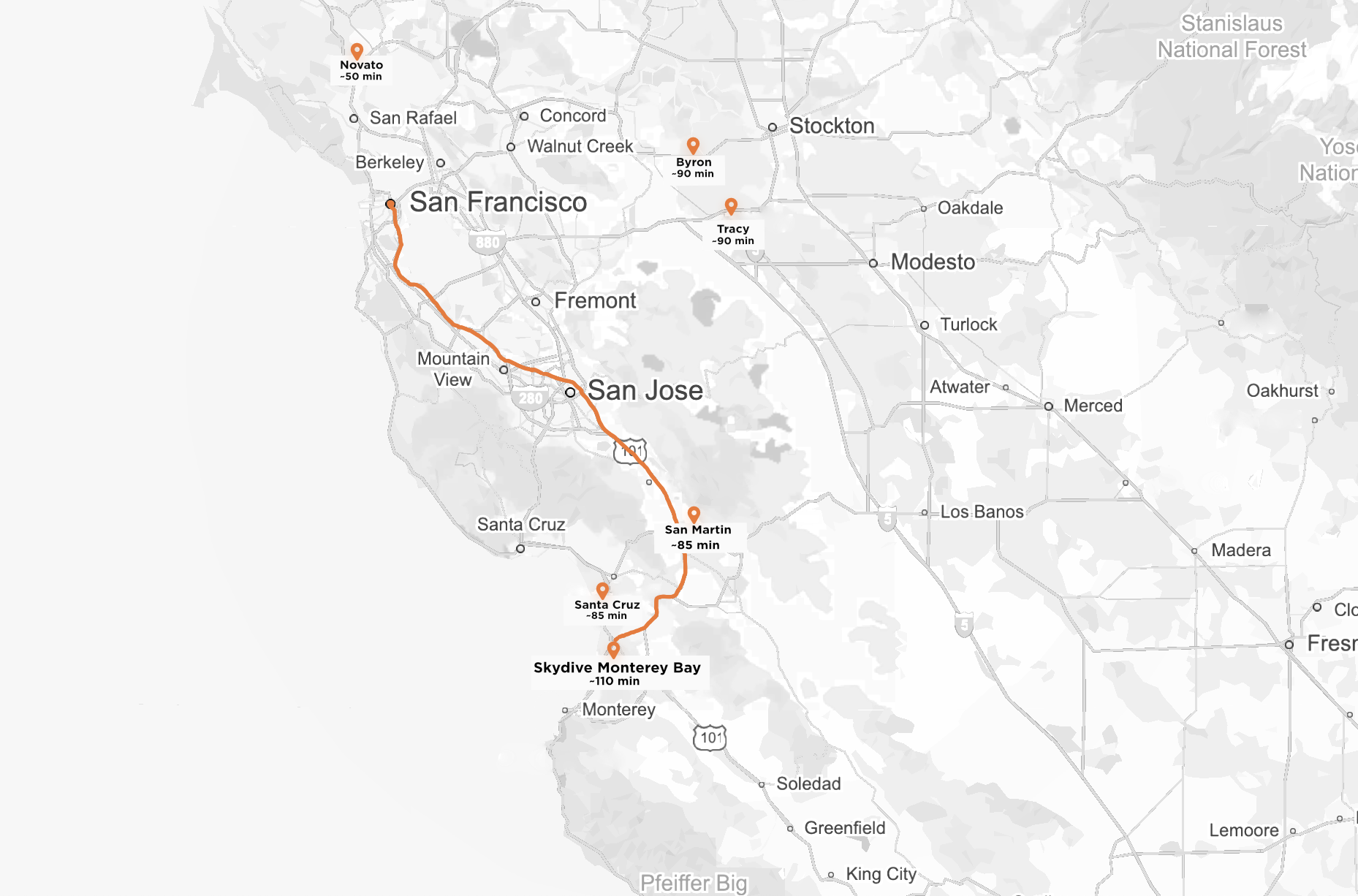
Traffic Tips
Monterey Bay & Santa Cruz: Southbound 101 can bottleneck around Gilroy; add buffer time if you’re leaving SF after 7 a.m. Weekends are smoother, but beach traffic builds by midday.
Davis & Tracy: Expect delays on I-80 and I-580 during weekday rush hours; plan to leave before 7 a.m. or after 9 a.m. Tractors really do share the road near Davis.
Novato: Bridge traffic is your wildcard — Golden Gate backups can turn a 45-minute drive into 90.
Parking
Public Transport & Ride Options
Quick Travel Tips
[Insert Visual Prompt: Map graphic showing SF and surrounding DZs, annotated with distance, drive time, and jump altitude]
So you’ve scoped out the options, weighed drive times, and imagined the freefall. Now it’s time to
make it official.
Skydive California Prices Even though average skydiving California prices are around $280, there are many different offers, packages, and skydiving...
READ MORE >7 Tips to Prepare for your First Skydive Until you’ve tried skydiving it’s very challenging to prepare for the...
READ MORE >10 Reasons to Try Skydiving People ultimately try skydiving because it might be the most fun activity you can try....
READ MORE >


